Why Life Purpose Matters (Now More Than Ever)
We live amid uncertainty, rapid change, and technological disruption. In this context, discovering your purpose stops being abstract philosophy and becomes a practical tool: it organizes decisions, focuses your energy, and—let’s be blunt—turns you into the architect of your own life.
When you clarify your why, even routine tasks gain meaning, and adversity becomes a training ground. As Epictetus put it: “What matters is not what happens, but how we react to it.”
What Is Life Purpose?
Your life purpose is the existential why that brings coherence and direction to your story.
It isn’t someone else’s goal or a motivational slogan; it’s a unique, authentic, sustainable direction born of self-knowledge—aligning what you think, feel, and do.
In scientific psychology, purpose in life is a pillar of Carol Ryff’s well-being model.
Different traditions have named it in different ways:
Purpose in Western philosophy, essence in existentialism, the Element in Ken Robinson’s work, Dharma in Hindu and Buddhist traditions, and Ikigai in Japanese culture.
All point to the same truth: human beings flourish when they find that inner compass that guides them beyond external pressures.
A genuine purpose shows clear traits: it’s personal and non-transferable, endures over time, transcends self-interest, and fuels a vital energy that aligns thoughts, emotions, and actions—in short, it lets us live in coherence.
Methods to Discover Your Purpose
There are several paths to clarity:
Logotherapy (Viktor Frankl). In his landmark book Man’s Search for Meaning, Frankl showed how—even in the harshest circumstances—we can find a sustaining why. Frankl invites us to revisit moments when life felt deeply meaningful and spot the patterns behind them. See the Viktor Frankl Institute (Vienna).
Deep visualization techniques (popularized by Stephen Covey). Imagine your own funeral:
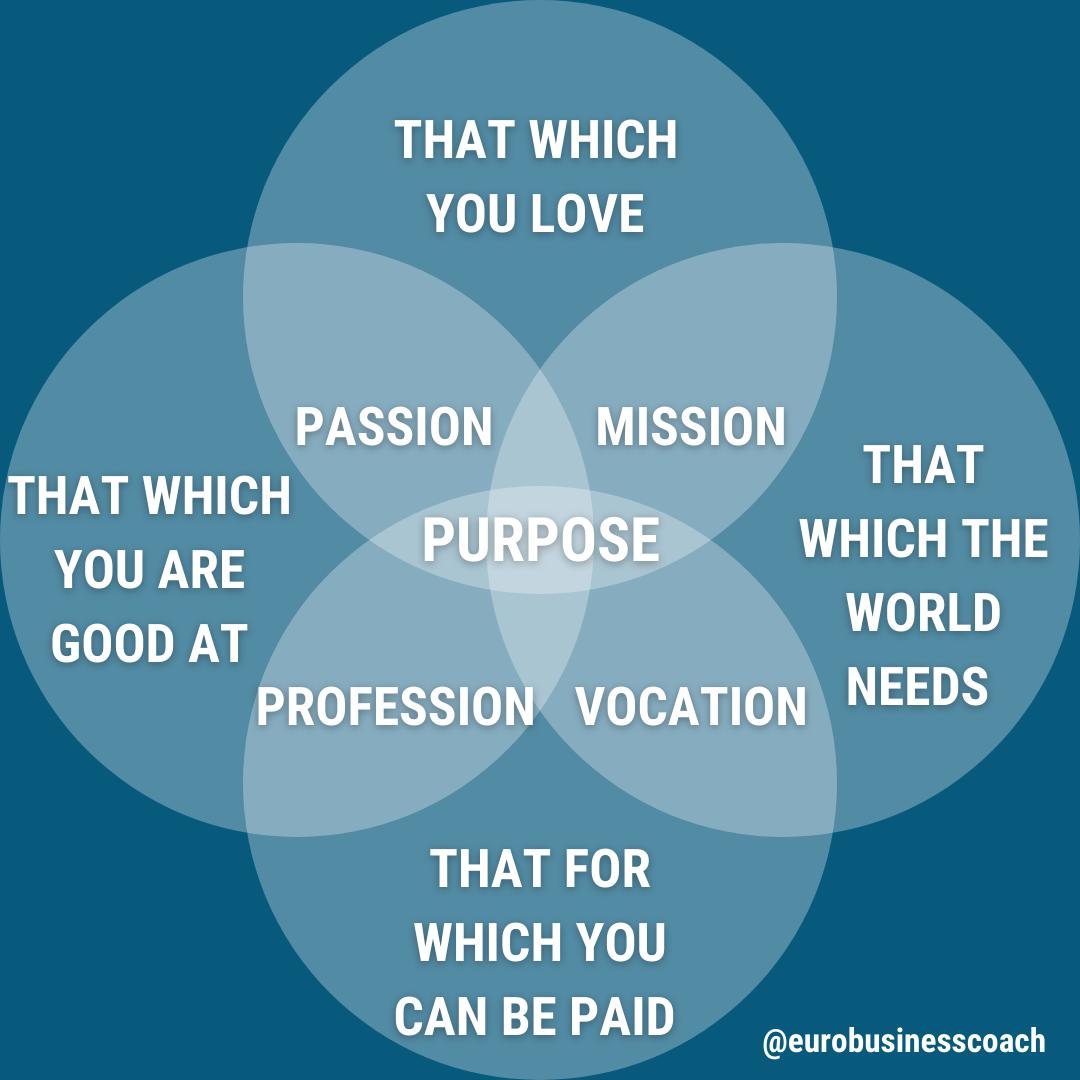
What legacy would you like to leave? How would you want to be remembered? What positive impact would you have had on the world? Uncomfortable? Maybe. Transformative? Often.And of course, Ikigai, with its essential questions: What do you love? What are you really good at? What does the world need from you? What can you be paid for? Honest answers illuminate the intersection where your reason for being comes alive.
Ikigai: The Japanese Art of Finding Meaning
Ikigai combines iki (life) and gai (value): what makes it worth getting up in the morning. More than a grand, epic mission, it’s a daily experience of meaning. Neuroscientist Ken Mogi frames ikigai in five pillars: start small, release yourself, harmony and sustainability, savor the little things, be here-now. A helpful gateway in English is the community at Ikigai Tribe.
Important note: the popular “four-circle” diagram is not Japan’s original definition. Still, as a Western thinking tool, it can help—if you treat it as a flexible map, not dogma.
A Practical 4-Dimension Map (useful for reflection)
Passion (what you love + what you do well): What energizes you? When do you feel most alive?
Mission (what you love + what the world needs): Which problems move you? How do you contribute?
Vocation (what the world needs + what you can be paid for): Where do impact and viability meet?
Profession (what you can be paid for + what you do well): Which competencies do others value in you?
Use this to form hypotheses—then validate them through micro-projects.
From Purpose to Action (No Beating Around the Bush)
State your “why” in one crisp sentence.
Translate it into quarterly OKRs: 3 objectives, each with 3–4 measurable key results.
Behavioral design: anchor micro-actions (15 minutes daily) to cues in your environment.
Weekly review: what did you do that expressed your ikigai? Adjust.
Quarterly review: does your calendar reflect your purpose—or just urgencies?
Want structured support to bring this down to earth? Explore our Executive Coaching to work with clear methods and metrics.
Overcoming Common Roadblocks
“I don’t know my purpose.” Shift from introspection to experimentation: 4 mini-projects in 4 weeks—learn from evidence, not guesswork.
“My purpose isn’t profitable.” Design a smart hybrid: stability + aligned projects; explore monetization models.
“I have too many passions.” Find the connecting thread (value/audience/problem).
“It’s too late for me.” Evidence shows purpose benefits at any age.
Conclusion: Your Moment Is Now
Purpose isn’t a destination; it’s a life strategy for well-being, performance, and health—including cognitive health. Start today: spend 15 minutes on an activity that expresses your ikigai, and repeat tomorrow. Small, well-aimed actions move mountains.
Ready to clarify your Life Purpose and turn it into measurable action?
Book an exploratory session with Euro Business Coach and let’s design your 90-day plan (OKRs + micro-habits + progress metrics). Contact us here.