What Is Organizational Architecture For?
Claudia Nieto Licht
October 25, 2026
When we work with business owners and executive teams, we often discuss strategy, leadership, culture, innovation, performance, and human resource management. Yet one question that should be central to those conversations rarely comes up:
How do all these elements work together to produce the results the organization needs?
The answer brings us to a concept that may sound technical but has very tangible implications for business effectiveness: organizational architecture.
In this Euro Business Coach series, we will explore what it means, why it matters, and how it can help organizations execute their strategies more effectively. In this first article, I want to begin with an idea: many challenges attributed to people, leadership, or culture cannot be understood—or resolved—unless we also examine how the work system is designed and how its elements fit together.
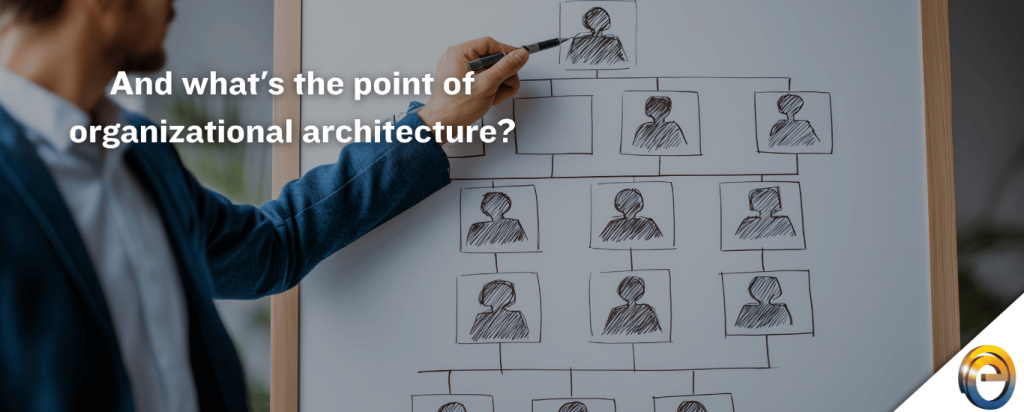
When people talk about organizational architecture, some think of the organizational chart, hierarchical levels, or the allocation of positions. These elements matter, but they represent only one part of the design.
Through his Star Model, Jay Galbraith explains that organizational design must maintain alignment among five components: strategy, structure, processes, rewards, and people. Structure distributes authority; processes connect information and decisions; rewards shape behavior; and talent practices help build the capabilities required by the strategy. When these elements send contradictory signals, an organization may have a sound strategy and still struggle to execute it.
The 7-S Framework, associated with McKinsey, broadens this perspective by highlighting the interaction among strategy, structure, systems, style, staff, skills, and shared values. David Nadler and Michael Tushman’s Congruence Model, in turn, encourages us to examine the fit among tasks, people, the formal organization, and the informal organization. The shared message is compelling: performance does not depend on any single component, but on alignment among interdependent elements.
Put simply, at Euro Business Coach, we understand organizational architecture as the way a company brings together its strategy, structure, processes, culture, leadership, and capabilities to turn its purpose into sustainable results.
This is not merely a theoretical concern. In its study *The State of Organizations 2023*, McKinsey found that, among the factors cited as causes of organizational complexity, 41% of respondents mentioned complex structures and 40% cited a lack of clarity in roles and responsibilities. Difficult-to-manage governance models, redundant activities, and unclear processes were also identified.
These figures do not prove that a complex structure alone causes poor performance. They do, however, send a message to executive teams: the way we assign responsibilities, coordinate decisions, and design processes can either make work easier or create obstacles.
When decisions require too many approvals, responsibilities overlap, or departments optimize their own performance metrics at the expense of overall results, the answer is not always to demand greater commitment or provide more training. It may be necessary to revisit the architecture that shapes how work gets done.
Another signal deserves attention. Gallup reported that in 2025, 20% of employees worldwide were engaged at work; in Latin America and the Caribbean, the figure was 30%. Engagement depends on many factors, and these numbers cannot be attributed to organizational architecture. Nevertheless, they remind us that business results and the employee experience should be considered together, not as separate agendas.
In our consulting work, we use an analytical framework that integrates seven elements. It is not intended to replace existing academic models; rather, it offers a practical way to focus executive discussions on the connections that need to be examined.
|
ELEMENT |
DIAGNOSTIC QUESTION |
|
STRATEGY |
Does the organization have a strategic plan, and has it clearly communicated that plan to everyone in the company? |
|
CULTURE |
To what extent does my company demonstrate the behaviors needed to execute its strategy? |
|
COMPETENCIES |
To what extent does my company have people with the competencies (knowledge, capabilities, attitudes, and skills) needed to achieve future objectives? |
|
CONSEQUENCES |
To what extent does my company have a management performance system (metrics, rewards, and incentives) to achieve future objectives? |
|
SYSTEMS |
To what extent does my company have the policies, structure, processes, metrics, and communication systems needed to achieve future objectives? |
|
LEADERSHIP |
To what extent does my company have the leadership needed (setting direction, demonstrating personal effectiveness, engaging others, and building capabilities) to achieve future objectives? |
|
COMMITMENT |
To what extent does the company have an approach to employee care, high performance, and development that recognizes employees’ contributions and improves their quality of life and well-being? |
When we ask executive teams to assess these elements, one of the most productive discussions often emerges from comparing their perceptions. Executives may share the same written strategy yet interpret priorities, the actual culture, available capabilities, or the incentives guiding decisions differently.
These differences are far from trivial. They may reveal alignment gaps that later surface as conflicts between departments, initiatives competing for resources, or contradictory decisions. The assessment should not end with a score: it should lead to questions, evidence, and priorities for action.
One of the thinkers who has most influenced how we analyze organizations is Russell L. Ackoff, a leading figure in systems thinking and systems design. His work urges us not to confuse activity with purpose, or the optimization of one part with improvement of the entire system.
Many organizations begin by designing activities, forms, and indicators, and only afterward ask what results they produce. A purpose-driven perspective reverses the sequence: first define what change we want to achieve and for whom; then design the processes, responsibilities, and measures that can help bring it about.
Consider the design of a performance appraisal system. Before discussing which competencies to measure, what rating scale to use, or which form to implement, it is worth asking:
The answers change how the system should be designed. If the purpose is to develop capabilities, an annual discussion focused on ratings will probably be insufficient. If the aim is to improve cross-functional results, assessing only individual goals may reinforce competing behaviors. Organizational architecture requires us to connect the tool to the result it is intended to produce.
In *The Fifth Discipline*, Peter Senge popularized the importance of thinking in systems: recognizing patterns, relationships, and effects that are not apparent when we view problems in isolation. Ackoff, drawing on a different tradition, likewise warned that the performance of the whole cannot be understood simply by adding up the performance of its parts.
This perspective offers several lessons for leaders:
Cause and effect may be separated in time. A decision made today—for example, cutting training to meet the budget—may lead to future costs in quality, turnover, or innovation capacity.
Local solutions may undermine overall results. A department may meet its target while shifting work, costs, or delays to another department or to the customer.
Visible problems may have structural roots. Recurring conflict between teams may reflect ambiguous responsibilities, incompatible incentives, or poorly defined processes, rather than interpersonal difficulties alone.
The formal organization is not the whole organization. Beyond the organizational chart, informal networks, habits, relationships of influence, and unwritten rules determine how decisions are actually made.
Changing one element affects others. Modifying the structure without adjusting processes, competencies, authority, and incentives may simply move the problem rather than solve it.
Nadler and Tushman’s Congruence Model is useful precisely because it prompts us to review the fit among the work to be done, the people doing it, the formal structure, and informal dynamics. The question is not merely whether each component makes sense in isolation, but whether they fit together and support the strategy.
Confusing architecture with the organizational chart. Redrawing reporting lines without examining how decisions, information, and accountability flow rarely solves the entire problem.
Addressing elements in isolation. Training people without reviewing the conditions that allow them to apply what they learn often limits the impact of that training.
Copying models from other companies. A structure that works in one organization may be unsuitable for another. Design must respond to each company’s strategy, environment, technology, capabilities, and history.
Designing activities without defining the intended result. People may work intensely without making progress on what matters. Activity must be linked to a verifiable contribution.
Ignoring the consequences reinforced by the system. When collaboration is expected but only individual results are rewarded, the system may end up encouraging internal competition.
Treating design as a one-time project. Organizational architecture needs to be revisited as strategy, markets, technology, size, or required capabilities change.
For business owners, managers, and human resources leaders, working on organizational architecture makes it possible to:
The starting point does not have to be a complex transformation. It may be one concrete question: What result are we failing to achieve, and which elements of the system might be contributing to that gap? The answer should be developed through data, conversations, and observation of how work is actually done—not solely through perceptions or a new organizational chart.
Before embarking on a restructuring, launching a leadership program, or investing in training, it is worth examining how well the system fits together. Is the strategy clear? Do processes support its execution? Does the culture reinforce priorities? Do we have the necessary competencies? Do recognition and measurement systems encourage the right behaviors? Are leaders building commitment and capabilities?
These questions do not replace a detailed analysis of each organization, but they help prevent piecemeal solutions. Organizational architecture is not about finding a perfect model and applying it uniformly. It is about deliberately designing and adjusting the relationships among a company’s components so they support its purpose and strategy.
At Euro Business Coach, we support business owners and executive teams through organizational transformation processes by connecting strategy, leadership, culture, competencies, systems, consequences, and commitment. Our approach combines conceptual frameworks with diagnostics and consulting experience to identify gaps, prioritize interventions, and build organizational capabilities.
An organization does not improve simply by optimizing one part. It improves when it understands how its parts relate to one another and aligns them to produce the results that truly matter.
📅 Request a complimentary discovery session
🌐 Visit euro-businesscoach.com
🔗 Follow us on LinkedIn and our social networks for more high-value content.
You may also be interested in: The Future of Work: Are We Developing Professionals or Simply Training Operators?

At Euro Business Coach, we support individuals, teams, and organizations in growing with purpose.
Our experience in consulting, coaching, and training allows us to offer comprehensive solutions that strengthen talent, optimize management, and connect strategy with action.
We work with a practical and human-centered vision to generate lasting changes that bring real value to companies, their employees, and their environment. We believe in conscious development, meaningful innovation, and results that leave a lasting impact.
© Euro Business Coach. All rights reserved.


Funded by the European Union – NextGenerationEU. However, the views and opinions expressed are solely those of the author(s) and do not necessarily reflect those of the European Union or the European Commission. Neither the European Union nor the European Commission can be held responsible for them.