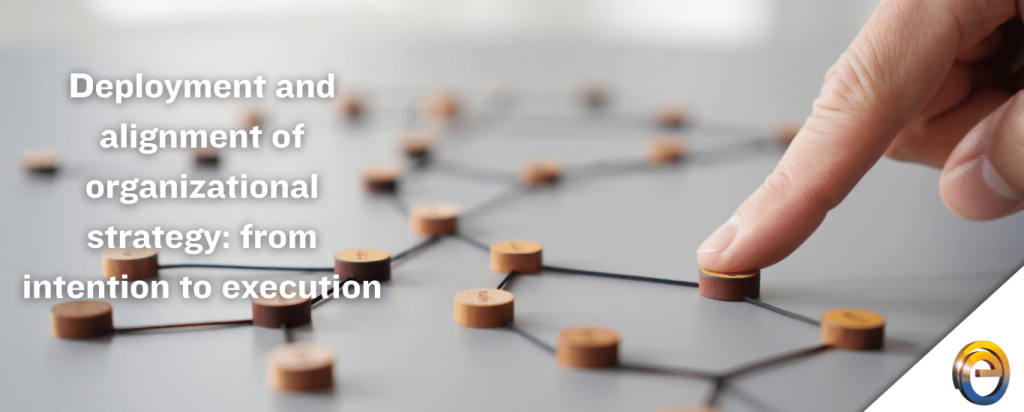
Deployment and Alignment of Organizational Strategy: From Intention to Execution
Claudia Nieto Licht
March 1, 2026
Coaching,En,Strategy
In previous blog posts, we have explored topics such as human talent, engagement, contribution, coaching, and leadership. In this new series, we focus on a central challenge for executives and managers: how to deploy and align organizational strategy to turn it into real results.
One of the most common problems in strategic planning processes is the difficulty of translating strategy into concrete actions within each area. In many organizations, we find leaders with strong technical expertise in their function, yet with limitations when it comes to articulating that knowledge with the company’s strategic objectives.
Strategy only creates value when it:
• is understood, • is embraced by leaders, • and is translated into operational decisions and priorities.
Some suggested steps:
1. Organizational Architecture: The Starting Point
The first step in properly deploying strategy is understanding the organizational architecture — in other words, the elements that explain how the company truly operates.
Models such as McKinsey’s 7S Framework, the contributions of Galbraith, and the proposals of Hay demonstrate that strategy does not operate in isolation: it depends on culture, competencies, systems, leadership, structure, and consequence mechanisms.
At Euro Business Coach, we work on this architecture through seven key dimensions:
Strategy, Culture, Competencies, Consequences, Systems, Leadership, and Commitment.
The goal is not to apply a theoretical model, but rather to enable leaders to build their own understanding of:
• what drives performance, • what slows it down, • and what must be aligned to execute the strategy.
2. Organizational Capabilities: The Advantage Lies Within
The second step is identifying organizational capabilities, a concept developed by Jay Barney, who argued that the strongest source of competitive advantage is not in the market, but within the organization.
These capabilities must meet four criteria (the VRIO model):
• be Valuable, • Rare, • Inimitable, • and Organized to generate value.
Determining which capabilities truly differentiate the company is not trivial. In fact, the lack of clarity on this point explains why many organizations constantly change strategies without consolidating a competitive advantage.
Authors such as Gary Hamel and C. K. Prahalad, in their book Competing for the Future, provided practical methodologies for identifying these core capabilities. Strengthening what distinguishes us is the essence of strategic direction.
3. Strategic Objectives: From Diagnosis to the Map
Once the architecture is understood and capabilities are defined, the next step is to formulate strategic objectives and structure them into a clear and actionable model.
Here, the contribution of Kaplan and Norton is key through the strategic map, which articulates the organization based on a cause–effect logic:
• Competent and committed people • Efficient internal processes, supported by innovation and technology • Satisfied and loyal customers • Sustainable financial results
This approach allows leaders to understand how their daily work impacts strategy and how each area contributes to the overall outcome.
4. Execution, Review, and Continuous Improvement
Defining strategy is only the beginning. The real challenge lies in disciplined execution, periodic review, and continuous improvement. Without these three elements, even the best strategy loses strength.
5. Market Strategy: Value Proposition and Business Model
A frequent question is: where does strategy fit in relation to the market, products, and customers?
To integrate this dimension, we use tools such as the Canvas model, which helps structure:
• the value proposition, • customer relationships, • how value is created, • and the balance between revenues and costs.
Defining the market and products is a prior and essential step to aligning internal strategy. Today, this process is further supported by advances in consumer neuroscience and data analytics, enabling more informed decisions about offerings and customer experience.
From Formulation to Execution
Deploying strategy is not a rhetorical exercise; it is a technical process that requires:
When leaders understand the organizational architecture, identify key capabilities, and work with clear objectives, strategy stops being a document and becomes a decision-making system.
How We Support Organizations at Euro Business Coach
At Euro Business Coach, we support organizations in the design, deployment, and alignment of their strategy through:
• Organizational architecture diagnosis • Identification of strategic capabilities • Development of strategic maps • Leadership support in execution
Our purpose is to ensure that strategy stops being a statement of intent and becomes a practical framework for guiding decisions, prioritizing resources, and generating sustainable results.
Because a company without strategic alignment does not lack effort: it lacks direction.